Link scaleApp.i18n.min.js in your HTML file:
<script src="scaleApp.min.js"></script>
<script src="scaleApp.i18n.min.js"></script>
Register the plugin:
core.use(scaleApp.plugins.i18n);If your application has to support multiple languages, you can pass an objects containing the localized strings with the options object.
var myLocalization =
{
  en: { welcome: "Welcome", ... },
  de: { welcome: "Willkommen", ... },
  ...
}
...
core.register( "moduleId", myModule, { i18n: myLocalization } );
Now you can access these strings easily trough the sandbox using the _ method.
Depending on which language is set globally it returns the corresponding
localized string.
sandbox._("myStringId");You can set the language globally by using the setLanguage method:
core.i18n.setLanguage( "de" );You can also set a global i18n object which can be used by all modules:
// pass it as a plugin option
core.use(scaleApp.plugins.i18n, {
  global: myGlobalObj
});

// or use the 'setGlobal' method
core.i18n.setGlobal( myGlobalObj );
Within your module you can define your local texts:
function(sandbox){
  init: function(){
    sandbox.i18n.addLocal({
      en: {hello: "Hello" },
      de: {hello: "Hallo" }
    });
  },
  destroy: function(){}
}
Subscribe to change event:
sandbox.i18n.onChange(function(){
  // update ui
});
Here is a sample use case for using the MVC plugin (in coffeescript).
core = new scaleApp.Core
core.use scaleApp.plugins.mvc
core.boot()
class MyModel extends core.Model name: "Noname"class MyView extends core.View
constructor: (@model, @sandbox, @template) -> super @model
# The render method gets automatically called when the model changes
# The 'getContainer' method is provided by the dom plugin
render: -> @sandbox.getContainer.innerHTML = @template @modelclass MyController extends core.Controller
changeName: (name) -> @model.set "name", namecore.registerModule "myModule", (@sandbox) ->
init: (opt) ->
# You can use any template engine you like. Here it's
# just a simple function
template = (model) -> "<h1>Hello #{model.name}</h1>"
@m = new MyModel
@v = new MyView @m, @sandbox, @template
@c = new MyController @m, @v
# listen to the "changeName" event
@sandbox.on "changeName", @c.changeName, @c
destroy: ->
delete @c
delete @v
delete @m
@sandbox.off @core.emit "changeName", "Peter"The state plugin is an approach to implement a Finite State Machine that can be used to keep track of your applications state.
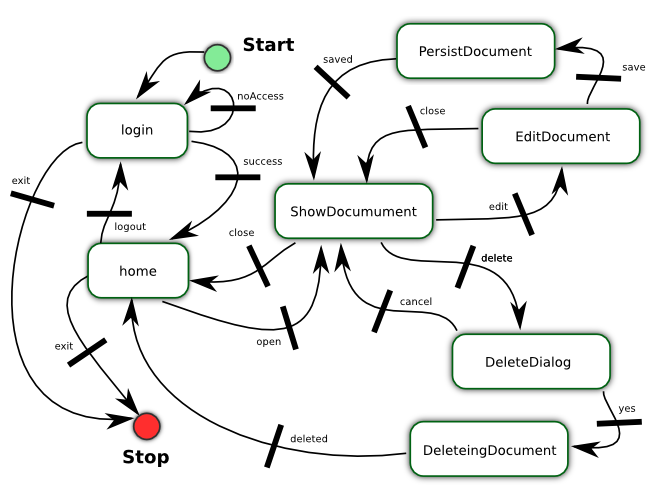
var s = new scaleApp.StateMachine({
  start: "a",
  states: {
    a:      { enter: function(ev){ console.log("entering state " + ev.to  ); }},
    b:      { leave: function(ev){ console.log("leaving state " + ev.from ); }},
    c:      { enter: [cb1, cb2], leave: cb3                                   },
    fatal:  { enter: function(){ console.error("something went wrong");      }}
  },
  transitions:{
    x:    { from: "a"        to: "b"     },
    y:    { from: ["b","c"]  to: "c"     },
    uups: { from: "*"        to: "fatal" }
  }
});

s.addState("d", { enter: function(){ /*..*/} });  // add an additional state
s.addState({ y: {}, z: { enter: cb } });          // or add multiple states

s.addTransition("t", { from: "b", to: "d" });     // add a transition
s.can("t");   // false because 'a' is current state
s.can("x");   // true

s.onLeave("a", function(transition, eventName, next){
  // ...
  next()
});

s.onEnter("b",function(transitioin, eventName, next){
  doSomething(function(err){next(err);});
});

s.fire("x");
s.current // bIf you include the permission plugin, all Mediator methods will be rejected
by default to enforce you to permit any message method explicitely.
core.permission.add("instanceA", "on", "a");
core.permission.add("instanceB", "emit", ["b", "c"]);
core.permission.add("instanceC", "emit", '*');
core.permission.add("instanceD", '*', 'd');
Now instanceA is allowed to subscribe to channel a but all others cannot
subscribe to it.
InstanceB can emit data on channels a and c.
InstanceC can emit to all channels.
InstanceD can perform all actions (on, off, emit)
but only on channel d.
Of course you can remove a permission at any time:
core.permission.remove("moduleA", "emit", "x");Or remove the subscribe permissions of all channels:
core.permission.remove("moduleB", "on");This is an adapter plugin for Strophe.js with some helpful features (e.g. automatically reconnect on page refresh).
core.xmpp.login("myjid@server.tld", "myPassword");
core.xmpp.logout();
core.xmpp.jid // the current JIDcore.register("parent", function(sandbox){
var childModule = function(sandbox){
return({
init: function(){
sandbox.emit("x", "yeah!");
},
destroy: function(){}
});
});
return({
init: function(){
sandbox.sub.register("child",childModule);
sandbox.permission.add("child", "emit", "x");
sandbox.sub.on("x",function(msg){
console.log("a child send this: " + msg);
});
sandbox.sub.start("child");
},
destroy: function(){}
});
});
// register the submodule plugin
core.use(scaleApp.plugins.submodule, {
inherit: true, // use all plugins from the parent's Core
use: [somePlugins], // use some additional plugins
useGlobalMediator: true, // emit and receive all events from the parent's Core
mediator: myCustomMediator // 'useGlobalMediator' has to be falsy
});
core.start("parent");
// the "parent" module starts a child within the init method
core.stop("parent");
// all children of "parent" were automatically stoppedcore.use(scaleApp.plugins.modulestate).boot()core.state.on("init", function(ev){
ev.instanceId // holds the instance ID
ev.moduleId // holds the module ID
});
core.state.on("init/myModule", function(ev){ /* */ });
core.state.on("destroy/myModule/anInstance", function(ev){ /* */ });core.lsModules(); // returns an array of module namescore.lsInstances(); // returns an array of instance namescore.lsPlugins(); // returns an array of plugin namescore.mixin(receivingClass, givingClass, override=false)core.countObjectKeys(object)core.clone(object)core.uniqueId(length=8)
- dom - basic DOM manipulations (currently only used for
getContainer)